
Canada remains one of the most desirable destinations in the world for people seeking better opportunities, political stability, high living standards, and a clear pathway to permanent residence. Whether your goal is to work, study, reunite with family, or build a new life from scratch, Canada continues to open its doors to immigrants from around the globe.
But here’s the reality most people don’t talk about: Migrating to Canada is not easy and it’s not random.
Many applicants face delays, refusals, or outright bans simply because they chose the wrong pathway or misunderstood the process. Others spend years applying without success, while some arrive in Canada surprisingly fast, sometimes in less than a year.
So what’s the difference?
Strategy.
This guide answers one of the most common questions aspiring immigrants ask:
“What are the fastest and simplest ways to immigrate to Canada?”
To answer that properly, you must first understand all the available pathways, then identify the one that aligns best with your background, finances, skills, and long-term goals. When done correctly, this approach helps you avoid unnecessary delays, refusals, and wasted money.
Immigrating to Canada can be difficult but there is almost always an alternative route. Whether you plan to work, study, visit, or settle permanently, Canada offers multiple legal immigration options.
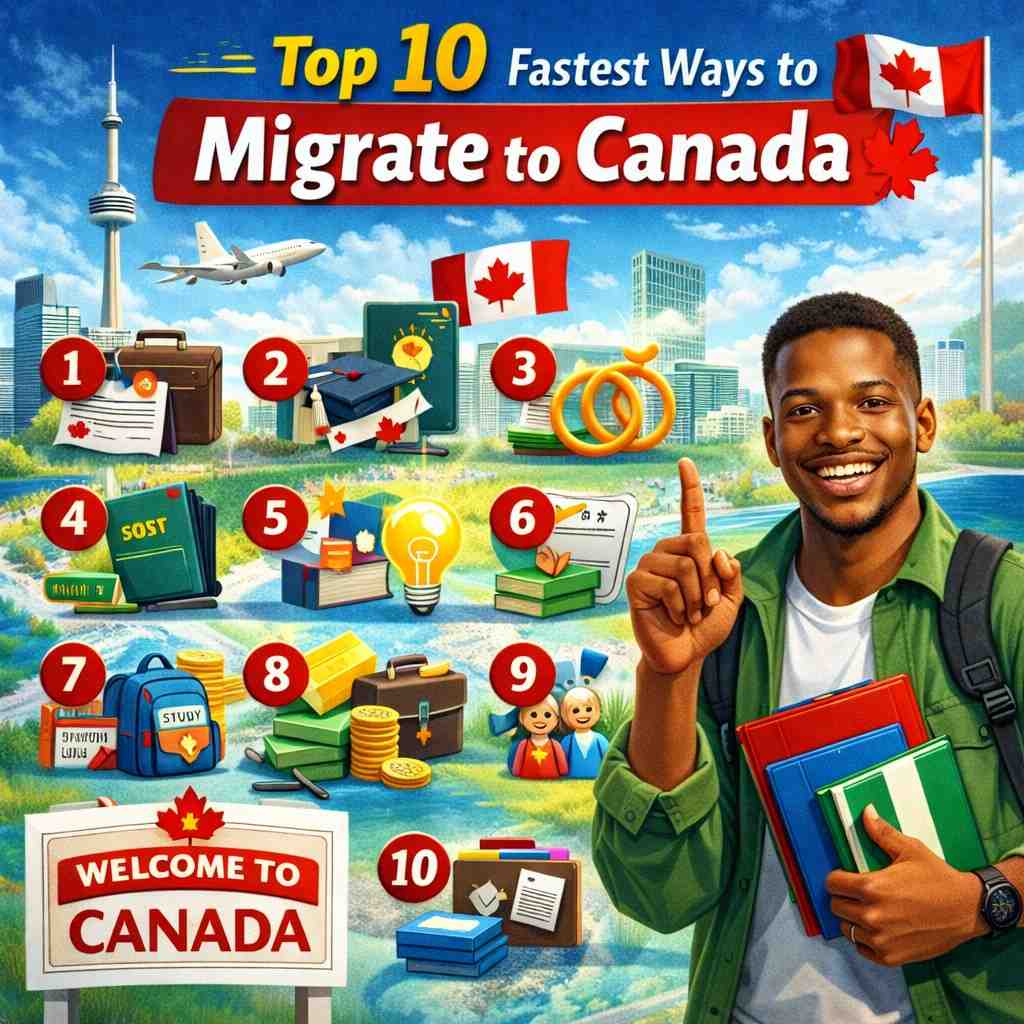
Below are the Top 10 fastest ways to migrate to Canada in 2026, explained in detail.
1. Express Entry (Fastest PR Pathway for Skilled Workers)
Express Entry remains Canada’s flagship immigration system and one of the fastest ways to obtain permanent residence.
Rather than being a single program, Express Entry manages applications for three federal immigration streams:
- Federal Skilled Worker Program (FSW)
- Canadian Experience Class (CEC)
- Federal Skilled Trades Program (FST)
Applicants are ranked using the Comprehensive Ranking System (CRS), which considers factors such as age, education, work experience, language ability, and adaptability.
Why Express Entry Is So Fast
- Processing time is often 6–8 months
- No job offer required (though helpful)
- Points-based, transparent system
- Increasing focus on occupation-specific draws
- Special draws for French-speaking candidates
Canada’s Immigration Levels Plan shows strong federal intake targets for skilled workers in 2026, making Express Entry one of the most reliable routes for qualified professionals.
Best for:
Skilled workers with strong education, work experience, and language proficiency.
2. Provincial Nominee Program (PNP)
If Express Entry is the engine, Provincial Nominee Programs are the turbo boost.
Each Canadian province and territory (except Quebec) runs its own immigration programs to meet local labor market needs. These programs often target specific occupations, industries, or demographics.
In 2026, provinces are expected to admit more immigrants through PNPs than through Express Entry, making this pathway extremely important.
Major Provincial Programs Include:
- Ontario
- British Columbia
- Alberta
- Manitoba
- Saskatchewan
- Nova Scotia
- New Brunswick
- Prince Edward Island
- Newfoundland and Labrador
- Yukon
- Northwest Territories
Many PNP streams are linked to Express Entry. A provincial nomination adds 600 CRS points, virtually guaranteeing an invitation to apply for permanent residence.
Best for:
Applicants with in-demand skills who may not score high enough under Express Entry alone.
3. Quebec Immigration Programs
Quebec operates its immigration system independently and selects immigrants based on its own criteria.
The province places heavy emphasis on French language proficiency and cultural integration. Quebec’s government has made it clear that preserving the French language is a top priority.
While some Quebec programs have been temporarily paused or restructured, economic immigration remains active and selective.
Key Points About Quebec Immigration:
- French proficiency is often mandatory
- Quebec selects its own skilled workers
- Economic immigration targets remain significant
- Intake numbers are carefully controlled
Best for:
French-speaking applicants or those willing to fully integrate into Quebec society.
4. Economic Pilot Programs
Canada uses pilot programs to address chronic labor shortages in specific sectors and regions. Many of these pilots are employer-driven, meaning you must secure a job offer first.
Major Pilot Programs Include:
- Atlantic Immigration Program (AIP)
- Caregiver Pilots
- Agri-Food Pilot
- Community Immigration Pilots
- Economic Mobility Pathways Pilot
The Atlantic Immigration Program, covering Nova Scotia, New Brunswick, Newfoundland and Labrador, and Prince Edward Island, has become permanent and continues to accept thousands of applicants yearly.
Best for:
Applicants with job offers in high-demand regions or industries.
5. Start-Up Visa Program
Canada’s Start-Up Visa Program is one of the most unique immigration pathways in the world.
Rather than requiring personal wealth, it focuses on innovation and scalability. Applicants must have a qualifying business idea supported by a designated Canadian organization such as:
- Angel investor groups
- Venture capital funds
- Business incubators
Successful applicants can obtain permanent residence while building their business in Canada.
Best for:
Entrepreneurs, innovators, and startup founders with scalable business ideas.
6. Provincial Business and Entrepreneur Programs
In addition to the federal Start-Up Visa, many provinces run their own business immigration streams.
These programs typically require:
- Investment capital
- Business management experience
- Active participation in business operations
- Job creation for Canadians
Each province has different financial thresholds and sector priorities.
Best for:
Experienced business owners and investors.
7. Self-Employed Immigration Programs
Canada offers self-employed immigration pathways at both federal and provincial levels.
Federal Self-Employed Program
Designed for individuals with experience in:
- Cultural activities
- Artistic fields
- Athletics
Applicants must demonstrate their ability to create employment for themselves and contribute meaningfully to Canada’s cultural or athletic life.
Quebec Self-Employed Program
Allows professionals and entrepreneurs to generate their own employment through business or professional practice.
Best for:
Artists, athletes, cultural professionals, and freelancers.
8. Family Sponsorship (Spouses, Partners, and Children)
Family reunification is a cornerstone of Canada’s immigration policy.
Canadian citizens and permanent residents can sponsor:
- Spouses
- Common-law partners
- Dependent children
Sponsored spouses and partners may also qualify for open work permits, allowing them to work while their application is being processed.
Best for:
Those with close family members already living in Canada.
9. Parents and Grandparents Program (PGP)
The Parents and Grandparents Program allows Canadians to bring their parents or grandparents to Canada permanently.
Due to high demand, the program operates through a lottery system, and invitations are issued randomly.
Applicants not selected can consider the Super Visa, which allows long-term stays in Canada.
Best for:
Canadian residents seeking family reunification.
10. Study Permit + Post-Graduation Work Permit (PGWP)
Studying in Canada remains a popular; though increasingly competitive; pathway to permanent residence.
The Typical Route:
- Study Permit
- Graduate from a Canadian institution
- Obtain a Post-Graduation Work Permit
- Gain Canadian work experience
- Apply through Express Entry or PNP
While this pathway exists, it is not guaranteed, and only a portion of international students successfully transition to permanent residence.
Best for:
Young applicants with long-term plans and sufficient financial backing.
General Requirements to Move to Canada
Regardless of the pathway, most applicants must:
- Hold a valid passport
- Demonstrate sufficient funds
- Maintain a clean criminal record
- Pass medical examinations
- Show intent to comply with immigration rules
- Improve language proficiency (English or French)
How to Move to Canada With Little or No Money
While challenging, it is possible.
Viable Options Include:
- Securing a job offer
- Canadian Experience Class
- Family sponsorship
- International Experience Canada (IEC)
- Visitor visa (strategic entry)
- Live-in caregiver programs
- Intra-company transfers through trade agreements
Each option comes with limitations, but combined with planning and persistence, they can open doors.
Conclusion
Canada plans to welcome hundreds of thousands of immigrants annually, even as it fine-tunes its intake systems. Despite rumors of an “immigration freeze,” Canada remains one of the most immigrant-friendly countries in the world.
The key to success is choosing the right pathway, preparing thoroughly, and avoiding common mistakes.
With the right strategy, migrating to Canada doesn’t have to take years; it can happen faster than you think.
If you’re serious about starting a new life abroad, Canada is still very much open.