
When people say a country has an “easy immigration process,” they usually don’t mean no requirements. What they really mean is:
- There’s a clear legal pathway (not guesswork).
- The rules are published and predictable.
- You can apply without needing rare connections.
- Processing is structured (even if it’s not always fast).
- The pathway can realistically lead to long-term residence (and sometimes permanent residence/citizenship) if you follow the rules.
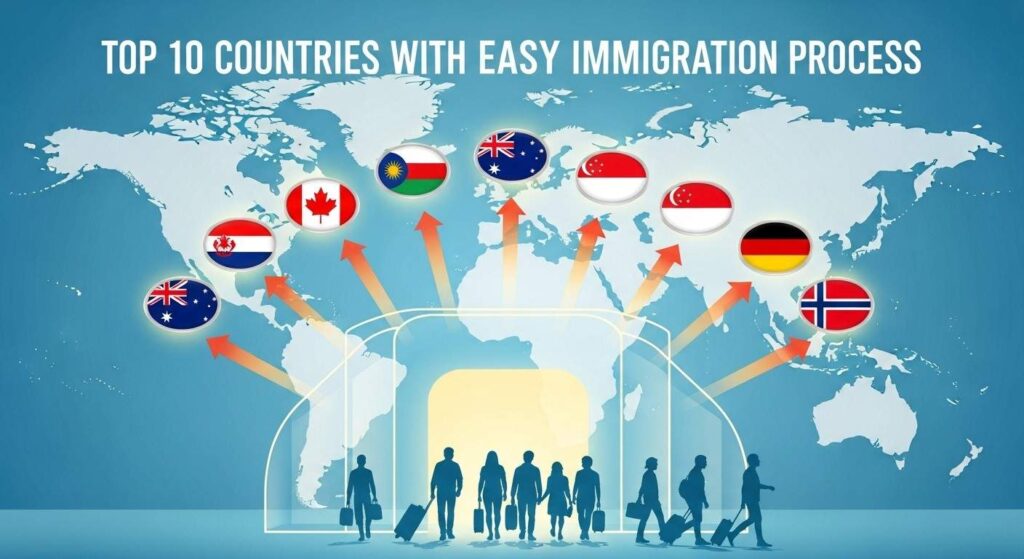
In 2026, many countries still welcome newcomers but mostly through specific pathways: skilled work, study-to-work, family reunification, and (in a few places) financially independent or remote-work options. This guide will help you understand those pathways as a beginner and choose a plan you can actually execute, without relying on rumors, “agent talk,” or misleading shortcuts.
Below are 10 countries that are widely seen as more “straightforward” for legal migration when you match the right program, and I’ll explain exactly what that means, who it fits, what you need, how long it takes, and how to avoid expensive mistakes.
Why this method works
Instead of chasing “the easiest country,” we use a pathway-first strategy:
- Pick the pathway that matches your real life
- Skilled work (job offer + work permit → residence)
- Points-based skilled migration (score + invitation → PR)
- Remote work / self-supported residence (proof of income → residence)
- Study-to-work (admission → student permit → work → residence)
- Family reunification (spouse/parent/child route)
- Work backwards from eligibility
- Do you have the education, work experience, language scores, income proof, or job offer the pathway requires?
- Build a document-ready application
- Most refusals happen because people are “almost eligible” or submit weak documentation.
- Use official sources as your foundation
- Immigration policies change. Official immigration/consular pages are the safest baseline.
This method works because immigration systems are designed to accept specific kinds of applicants. When you stop forcing a mismatch and instead align yourself with the right track; your chances increase massively.
Top 10 countries with relatively straightforward immigration pathways in 2026
1) Canada
Why many people call it “easy” (when you’re eligible): Canada has a very structured economic immigration system (not perfect, but clear). If your profile matches what they are inviting, you can move from “application” to permanent residence without needing an employer in some cases.
Most practical pathways (beginner-friendly explanation):
- Express Entry (economic PR system): You create a profile and may receive an invitation based on points (CRS).
- Category-based selection: Canada also runs targeted invitations for specific skills/language/occupations.
Who it fits best:
- Skilled workers with strong English/French, education, and experience.
- People in targeted occupations (varies by year/needs).
Typical requirements:
- Passport, education credentials, work history proofs.
- Language test results (IELTS/TEF, etc.).
- Police clearance, medicals, proof of funds (depending on program).
Reality check:
Canada isn’t “easy” if your profile is weak but it’s one of the clearest systems to understand and plan for because the framework is published and standardized.
2) Germany
Why it’s considered straightforward in 2026: Germany has expanded skilled immigration rules and created clearer routes for qualified workers; including the Opportunity Card (Chancenkarte) concept for job-seeking under defined conditions.
Most practical pathways:
- EU Blue Card / skilled worker permits: If you have a recognized qualification and a qualifying job offer.
- Opportunity Card (Chancenkarte): A structured route that can allow job seeking under a points/criteria approach (rules depend on your profile).
Who it fits best:
- Skilled workers in in-demand fields (IT, engineering, healthcare, trades; depending on recognition).
- People willing to meet language/qualification recognition requirements.
Big beginner tip: Germany often cares about recognition of qualifications. If you ignore this step, you waste months.
3) Portugal
Why people call it easy: Portugal has long been known for residence pathways that are relatively understandable, especially for people who can show stable income and comply with residency rules. Official visa categories include residence visas for “people living from passive income,” alongside other national visa types.
Most practical pathways:
- Residence visa for passive income (often discussed as “D7”): Consular checklists and documentation requirements are typically spelled out clearly.
- Other residence visas based on work, entrepreneurship, etc. (category depends on your situation).
Who it fits best:
- People with provable stable income (remote income, pensions, investments, etc.) and a realistic plan to live there legally.
Important note (don’t skip this):
Portugal uses “means of subsistence” references tied to official benchmarks.
And documentation expectations can be strict; especially about the stability and origin of funds.
4) Spain
Why it’s considered straightforward: Spain has a defined telework/digital nomad visa route published through consular channels, with typical requirements like proof of remote work, financial means, and background checks.
Most practical pathways:
- Telework (digital nomad) visa: For remote workers with qualifying contracts and financial means.
- Other long-stay options exist, but telework is the one many beginners can understand quickly.
Who it fits best:
- Remote employees/contractors who can prove stable income and remote work structure.
Beginner warning:
A lot of people misunderstand “remote.” If your income depends on local work in Spain, you may not qualify under telework rules.
5) Ireland
Why it can be straightforward: Ireland runs a formal employment permit system, and official processing updates are publicly posted (so you can track what’s happening instead of relying on rumors).
Most practical pathway:
- Critical Skills Employment Permit (CSEP): Designed for shortage occupations and is one of the clearer routes for skilled workers.
Who it fits best:
- People in clearly in-demand roles, with a genuine job offer.
What “easy” means here:
Not “anyone can go.” It means: if your job matches and your employer is real, the route is structured and trackable.
6) New Zealand
Why it’s considered structured: New Zealand’s work-to-residence logic is very explicit in official guidance. For example, the Work to Residence Visa is clearly described for people who have worked in certain in-demand roles with accredited employers for a defined period.
Most practical pathways:
- Accredited Employer Work Visa (AEWV): Work visa route with defined document expectations (including police certificates).
- Green List pathways: Including “Straight to Residence” (Tier 1) and “Work to Residence” (Tier 2).
Who it fits best:
- Skilled workers who can secure accredited employment and meet the job/skill requirements.
7) Australia
Why it’s often included:
Australia remains one of the most recognizable systems for skilled migration. Even though it can be competitive, the structure is clear, and official visa categories are well-defined; like the Skilled Independent visa (subclass 189).
Most practical pathways:
- Skilled Independent (189): Points-tested, no sponsor required (but highly competitive).
- State-nominated options (190, etc.) depending on occupation lists and quotas.
Who it fits best:
- Applicants with strong points: age, degree, experience, English.
8) Finland
Why it can be “easy” for the right person: Finland offers a Fast Track concept for certain categories like specialists; meaning decisions can be accelerated when you meet the requirements and apply properly.
Most practical pathway:
- Fast track for specialists (where eligible).
Who it fits best:
- Specialists with a real job offer and clean documentation.
Reality check:
Fast decision doesn’t automatically mean easy permanent residence. Some long-term rules can change, so always confirm your specific residence pathway carefully.
9) Mexico
Why it’s often surprisingly straightforward: Mexico has a relatively direct residency framework for people who can meet financial solvency requirements, and consulates publish specifics (amounts can vary by consulate and year). Here’s an example consular outline of temporary resident financial requirements.
Most practical pathways:
- Temporary Resident Visa (often based on financial solvency), which can later be renewed and may lead to longer-term status depending on your route and compliance.
Who it fits best:
- People with stable income/savings who want a legal residence path without needing employer sponsorship (depending on consulate interpretation).
Beginner warning:
Mexico’s thresholds and interpretations can vary by consulate. Always verify your consulate’s checklist before paying for appointments.
10) Estonia
Why it’s seen as clear: Estonia has a well-known Digital Nomad Visa concept for remote workers that is relatively easy to understand: prove remote work + meet an income threshold + meet standard requirements. Estonia’s official e-Residency portal also clarifies that digital nomad visa is a temporary stay option (not the same as e-Residency).
Most practical pathway (for beginners):
- Digital Nomad Visa: Typically up to 1 year for remote work (details depend on your application and embassy).
Who it fits best:
- Remote workers with stable, provable income.
Important note:
A digital nomad visa is not automatically “immigration to permanent residence.” It’s a legal stay route; useful for mobility, but you must plan what comes next if your goal is long-term settlement.
Step-by-step process (how to apply the right way in 2026)
Here’s a practical step-by-step method you can follow, no matter which country you choose.
Step 1: Decide what you want (and be honest)
Ask yourself:
- Do I want permanent residence, or am I okay starting with a temporary legal stay?
- Am I trying to move alone, with spouse, with kids, or all of them?
- Do I need a country where I can work immediately, or can I move with savings/income first?
This matters because some routes are built for work (job-based), while others are built for income-based residence (remote/self-supported).
Step 2: Choose your pathway before you choose the country
Pick one “main pathway”:
- Skilled work (job offer)
- Points-based skilled migration
- Remote/income-based residence
- Study-to-work
- Family route
Then match it to a country that supports it clearly.
Step 3: Check eligibility like an immigration officer would
This is where people lie to themselves.
Create a simple checklist:
- Education level (and whether recognition is required)
- Work experience (years + occupation)
- Language scores (required? recommended?)
- Proof of funds (how much? how long must it sit?)
- Background: police report, travel history, refusals
- Medical requirements (if applicable)
Step 4: Build your “document pack” early
Most successful applicants don’t start with the online form. They start with documents.
Typical documents across most countries:
- International passport (valid for 6–12+ months)
- Birth certificate (sometimes)
- Marriage certificate (if spouse is joining)
- Police clearance(s) for required countries
- Proof of funds / bank statements
- Employment letters + payslips + tax documents
- Education certificates + transcripts
- CV and reference letters
- Medicals (where required)
- Health insurance (common in many places)
Step 5: Apply through the official channel (or the official visa center)
- Use the official immigration portal, embassy/consulate, or approved visa application center if required.
- Pay only official fees (and keep receipts).
Step 6: Biometrics, interview, and “requests for more info”
Many applications fail here because people panic or delay.
If they ask for:
- Updated bank statements
- Better employment proof
- Clarification letters
Respond quickly, clearly, and with stronger evidence than before.
Step 7: Track your application and prepare for the move
While waiting:
- Gather original documents for travel
- Prepare accommodation plan
- Plan initial costs (rent, transport, insurance)
- Learn basic local rules (registration, tax ID, etc.)
Requirements and eligibility (what “easy” really requires)
Even “easy countries” require credibility. These are the main eligibility pillars you’ll see again and again:
1) Proof you can support yourself (financial credibility)
This can be:
- Proof of funds (savings)
- Payslips and salary history
- Remote work income proof
- Sponsor/employer proof
Income-based visas are strict about the origin and stability of funds.
2) Proof you will obey the visa rules (behavior credibility)
- Clean travel history helps
- Honest disclosures matter
- Overstays or fake documents destroy your chances
3) Proof your “story” makes sense (logic credibility)
Immigration officers don’t just check documents; they check the story:
- Why this country?
- Why this route?
- Why now?
- How will you survive legally?
If your story is weak, even correct documents may still fail.
Mistakes to avoid (these ruin applications)
- Picking a country based on TikTok
- “Easy” for someone else may be impossible for you.
- Using fake bank statements or “borrowed funds”
- Many systems check patterns, deposits, and consistency.
- Applying with a weak employment letter
- Generic letters without role, salary, dates, and verification contacts often fail.
- Ignoring police certificate rules
- For example, New Zealand tightened rules around submitting police certificates with AEWV applications.
- Submitting translations that are not accepted
- Use certified translations where required.
- Assuming a temporary visa automatically becomes permanent
- Some visas are designed for temporary stay only (common with nomad-style visas).
- Paying “agents” to invent jobs
- If the job offer isn’t genuine, you can be banned.
How long the process takes (what to expect in real life)
Processing times change constantly, but here’s the honest way to think about it:
What controls timelines
- Completeness of your application
- Country workload and quotas
- Your background checks
- Whether you need credential recognition
- Whether your employer is accredited (for job-based routes)
A practical expectation range (planning mindset)
- Some job-based permits can be relatively quick when the system is streamlined and documents are complete.
- Points-based PR systems can take longer because you may need an invitation before you even apply.
- Some governments publish current processing status updates (for example, Ireland posts processing dates for permit types).
Best planning rule: assume several months end-to-end unless the program explicitly offers fast-track service and you clearly qualify.
What to do after applying (your waiting period plan)
1) Don’t go silent, stay “document-ready”
While waiting, keep:
- Bank statements current
- Employment stable (if job-based)
- Contact details consistent (email/phone)
2) Prepare your relocation budget properly
Typical first-month costs:
- Housing deposit + first rent
- Transport
- Local registration costs
- Health insurance (if not already arranged)
- Emergency cushion
3) Learn your arrival obligations
Many countries require:
- Address registration
- Tax ID registration
- Residence card appointment
- Local health insurance registration (depending on route)
4) Avoid “status-breaking” behavior
If you’re granted a visa/residence:
- Don’t violate work restrictions
- Don’t overstay
- Don’t assume renewals are automatic
FAQs – Frequently Asked Questions
1) What does “easy immigration” really mean?
It means the process is clear and legal, with defined eligibility rules. It does not mean “anyone can enter” or “guaranteed approval.”
2) Which is easiest for someone without a degree?
Often job-offer routes in trades/care roles can be more realistic than points-based PR. But it depends on the country’s shortage lists and employer demand.
3) Can I immigrate without a job offer?
Sometimes, yes, through points systems (e.g., skilled migration) or income-based residence routes (where allowed). But you must prove you can legally support yourself.
4) Are digital nomad visas a direct path to permanent residence?
Usually, no. They’re typically designed as temporary stay visas; useful, but you need a separate long-term plan if settlement is your goal.
5) What’s the biggest reason applications get refused?
Weak documentation, inconsistent stories, fake documents, and failure to meet core requirements (funds, job genuineness, background checks).
6) Is Canada still a good option in 2026?
Canada remains a major destination, but outcomes depend heavily on your profile and the categories being targeted. Category-based selection is part of how invitations are structured.
7) Do I need an immigration lawyer?
Not always. Many people apply successfully using official guidance. A lawyer can help when your case is complex (refusals, unusual histories, dependents, legal issues).
8) What documents should I start preparing first?
Start with: passport, CV, education records, employment letters, bank statements, and police clearance planning (some take time).
9) How do I avoid scams?
Use only official government pages, official visa centers, and reputable employers. Never pay for “guaranteed visa” or fake job offers.
10) Can I apply with my spouse and children?
Often yes, but requirements increase (more funds, additional documents, marriage/birth certificates, etc.). Always check dependent rules in the specific program.
11) Should I apply to multiple countries at once?
You can, but it can become expensive and confusing. A better strategy is: one main plan + one backup plan.
12) What if my visa is refused?
Don’t panic. First, read the refusal reason carefully. Some systems allow review/appeal in certain cases, and you can often reapply stronger if you fix the real weakness. (For example, Ireland’s permit system describes review options for refusals.)
Conclusion
In 2026, the smartest way to “immigrate easily” is not chasing the country with the loudest hype; it’s choosing a country where your profile matches a clearly defined legal pathway, then preparing your application like a serious adult with a plan.
If you remember only one thing from this guide, let it be this:
Immigration gets easier when your pathway fits your reality and your documents prove it.