
What if you could relocate to another country, earn a recognised degree, and still receive a monthly living allowance; without draining your family’s savings?
That’s not fantasy. It happens every year.
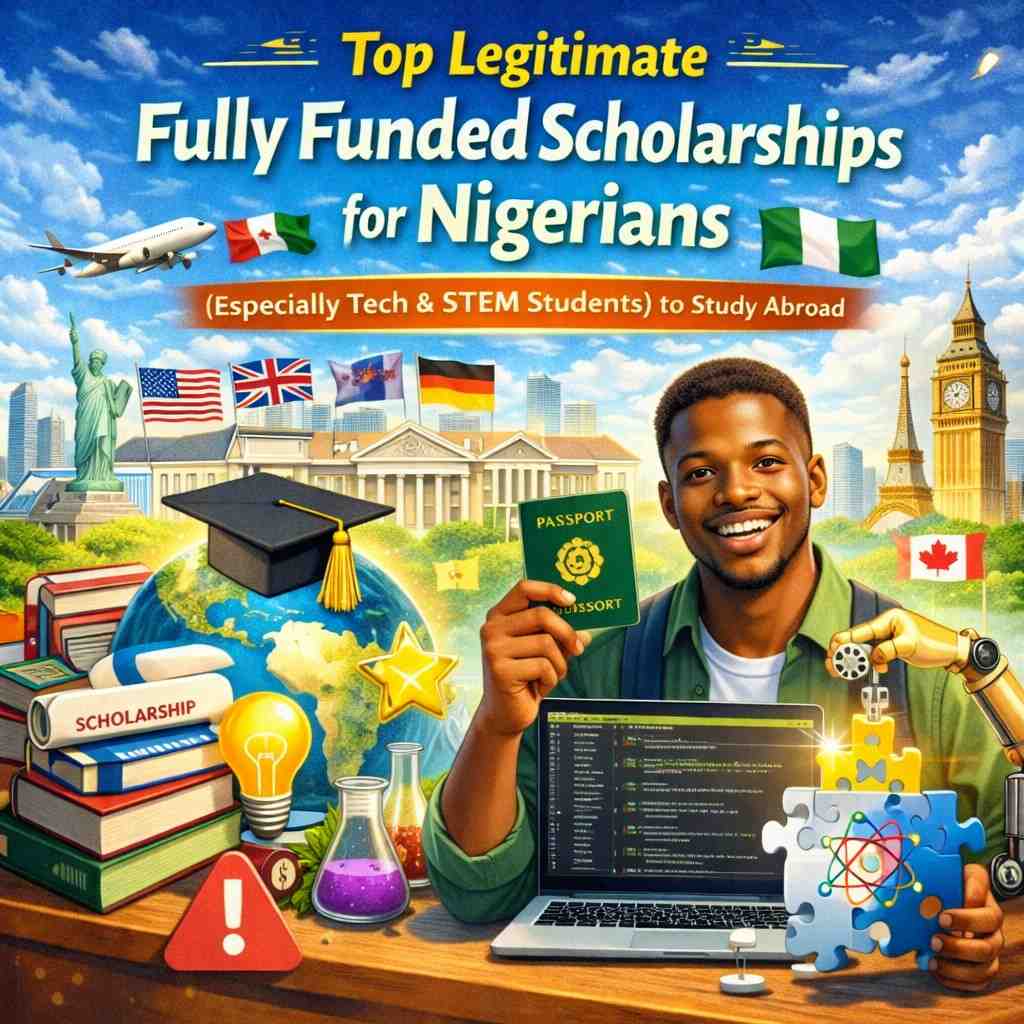
Fully funded scholarships exist specifically for high-performing students and young professionals from countries like Nigeria. Some cover everything (tuition, flights, health insurance, living stipend). Others cover the big costs and still make studying abroad realistic.
This article is written to help you avoid two common problems:
- Wasting time on fake “scholarships” and shady agents
- Missing deadlines because you didn’t know the scholarship cycle
What “Fully Funded” Really Means (Don’t Skip This)
A scholarship is truly “fully funded” when it covers most or all of:
- Tuition / fees
- Living stipend (monthly allowance)
- Flights / travel support
- Health insurance
- Sometimes: relocation grant, thesis support, research funding
If a programme calls itself “fully funded” but still expects you to pay most major costs, treat it as partial funding.
Quick Snapshot: Credible Fully Funded Options Nigerians Actually Win
Here are the best-known, legitimate option; grouped by what they’re best for.
Best for Master’s (Policy, Development, STEM-friendly)
- Chevening (UK) — fully funded master’s in any subject; applications typically open Aug and close early Oct (for 2026–27, it opened Aug 5, 2025 and closed Oct 7, 2025).
- Erasmus Mundus Joint Masters (EU) — joint degrees across multiple European universities; scholarships contribute to tuition + travel/visa + living allowance.
- DAAD EPOS (Germany) — development-related postgraduate courses; funding + list of course-specific deadlines.
- Joint Japan/World Bank (JJ/WBGSP) — development-related master’s with two annual application windows in 2026 (Jan–Feb, and Mar–May).
For PhD
- Vanier CGS (Canada) — $50,000/year for 3 years, via nomination by a Canadian institution.
- Swiss Government Excellence Scholarships — postgraduate research; requires a Swiss academic supervisor backing your application.
- Melbourne Research Scholarship (Australia) — fee offset + stipend (University of Melbourne publishes annual rates).
Best for Undergrad (Elite need-based routes)
- Yale (USA) — Yale undergraduate aid is need-based (not merit scholarships) and can meet 100% of demonstrated need for admitted students.
(Important: Yale doesn’t give “merit scholarships.” If a site says “Yale merit scholarship,” that’s a red flag.)
The Scholarships (Clean, High-Value Breakdown)
1) Chevening Scholarships (UK)
Best for: Master’s (any field, including AI, data science, cybersecurity—if your course fits your career story)
What it covers: Full funding package (tuition + living costs + travel support, etc.)
Who wins: People with strong academics + leadership + clear plan to return and contribute
Deadline cycle: For 2026–27, the application window ran Aug 5, 2025 → Oct 7, 2025.
Tip for tech applicants: Chevening is big on impact. Don’t sell “I love tech.” Sell “I’m building solutions for X problem in Nigeria/Africa and this degree is the bridge.”
2) Erasmus Mundus Joint Masters (European Union)
Best for: Master’s programs across 2+ countries (many tech-heavy programmes exist)
What it covers: Participation costs + contribution to travel/visa + living allowance (exact amount varies by programme).
Reality check: Erasmus is competitive. Your edge is a strong academic record + a focused motivation letter that matches the programme’s direction.
3) DAAD EPOS (Germany)
Best for: Postgraduate courses with development impact (includes some STEM/energy/environment systems programmes)
What it covers: Stipend + other supports; deadlines vary per course, and DAAD publishes deadline lists by intake year.
Tip: Don’t treat EPOS like a single scholarship. It’s a network of programmes, each with different requirements.
4) Joint Japan / World Bank Graduate Scholarship (JJ/WBGSP)
Best for: Development-related master’s at approved participating programmes
What it covers: Tuition + stipend + travel + insurance (programme structure is clearly defined by World Bank)
Application windows (2026):
- Window #1: Jan 15 → Feb 27, 2026
- Window #2: Mar 30 → May 29, 2026
Big requirement trend: Work experience + clear development impact story.
5) Fulbright Foreign Student Program (USA)
Best for: Master’s/PhD study and research in the U.S.
What it covers: A full funding package (varies by country programme), administered via official Fulbright channels
Nigeria-specific note: The U.S. Embassy in Nigeria lists a strict annual deadline (example shown as June 1 on their programme page).
Advice: Fulbright rewards clarity. A sharp research direction beats vague ambition.
6) Australia Awards (for eligible African applicants)
Best for: Master’s (often development and public-sector aligned; some STEM routes exist depending on priority areas)
Key eligibility examples for Africa intake: Minimum age and work experience requirements are commonly specified in official intake documents.
Important: Australia Awards requirements can be region-specific and intake-specific. Always follow the official intake document for your region.
7) Vanier Canada Graduate Scholarships (Canada)
Best for: Top-tier PhD candidates with leadership + research excellence
Value: $50,000/year for three years
How it works: You must be nominated by a Canadian institution.
If you’re in tech: Your research proposal quality matters a lot. So does proof you can deliver.
8) Swiss Government Excellence Scholarships (Switzerland)
Best for: Research-focused postgraduate applicants
Core requirement: Your application must be backed by a Swiss academic supervisor willing to guide your proposed research.
Practical meaning: You don’t start with the scholarship form; you start by finding a lab/supervisor match.
9) Melbourne Research Scholarship (Australia)
Best for: Master’s by research and PhD
What it includes (University of Melbourne): Fee offset + published stipend rates (updated by year).
Reminder: Research scholarships usually require either a strong supervisor match or a strong admission pathway; sometimes both.
10) Mastercard Foundation Scholars Program (Partner Universities)
Best for: High-achieving students with financial need and leadership potential (varies by partner institution)
What it supports: Financial + academic + psychosocial support, including tuition-related support and development programming.
Key point: It’s not a “random online application.” You apply through partner universities.
11) MEXT (Japan)
Best for: Undergraduate and graduate study in Japan
What it offers (official outline): Tuition exemption + monthly stipend ranges + travel support (varies by track).
12) Chinese Government Scholarship (CSC) (China)
Best for: Master’s/PhD in a wide range of STEM fields
Typical stipend ranges (examples listed by multiple institutions): around 3,000 RMB/month (Master’s) and 3,500 RMB/month (PhD), plus tuition coverage, etc.
13) Yale Undergraduate Financial Aid (USA)
Best for: Undergraduate applicants admitted to Yale who demonstrate financial need
Important truth: Yale’s undergraduate aid is need-based, and Yale states it meets 100% of demonstrated financial need for admitted students.
This is included because many people search for “Yale scholarship,” but the real path is: get admitted first, then funding is assessed.
Tech Student Advantage: What Scholarship Reviewers Love to See
If you’re applying in tech/STEM, your application becomes much stronger when you show:
- A clear focus (e.g., AI for health, power systems, cybersecurity, data engineering)
- Evidence of work: GitHub, portfolio, published projects, research, internships
- Real-world impact: what problem you’ve solved or are solving
- A believable career plan: what you’ll do after graduation and why it matters
Scholarship Scam Checklist (Read This Twice)
Avoid any “scholarship” that:
- Requires you to pay a “processing fee” to be selected
- Promises guaranteed admission or guaranteed visa
- Uses vague language like “selected candidates will be contacted” with no credible institution attached
- Pushes you to a WhatsApp “agent” as the official method
Legitimate scholarships are competitive, transparent, and tied to known institutions.
A Simple Strategy That Actually Works
If you want real results, do this:
- Pick 3–5 scholarships that match your profile (degree level + field)
- Build one strong “core pack” (CV, transcript plan, recommenders, SOP template)
- Tailor each application; don’t copy/paste blindly
- Apply early; systems crash near deadlines
- Keep proof of everything you submit
Disclaimer
This article is for educational purposes only. Scholarship rules, deadlines, and benefits can change. Always confirm details on the official scholarship or university pages before applying.