
Migrating to Canada can be exciting, new opportunities, better work prospects, world-class education, and a chance to build a stable future. But if we’re being honest, the visa and immigration process is where many people get humbled.
Every year, thousands of applicants submit Canadian visa applications hoping for a fresh start. And every year, many get refused, not always because they’re “unqualified,” but because of avoidable mistakes: missing documents, inconsistent information, weak financial proof, or using the wrong visa pathway entirely.
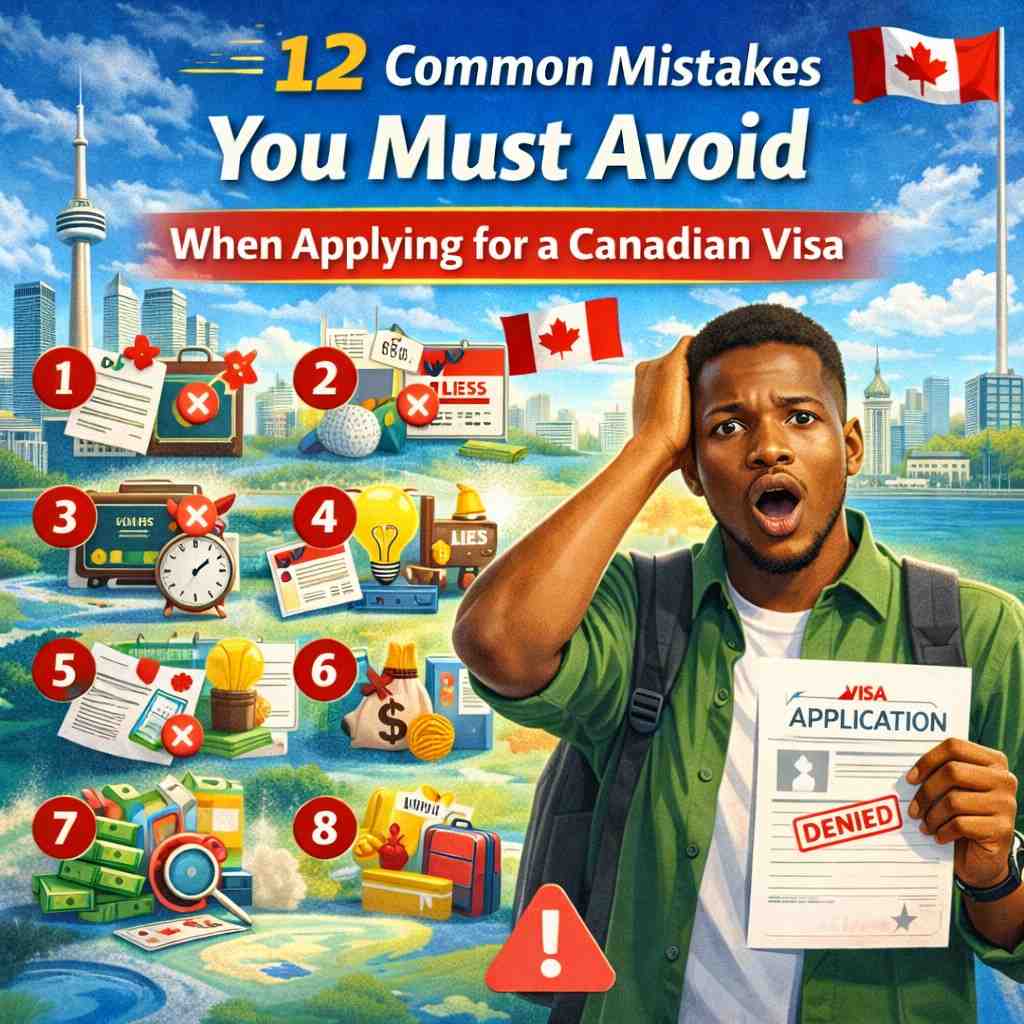
Sometimes, a tiny detail; a wrong date, an unsigned form, an unexplained refusal history; can trigger delays, rejections, or even a misrepresentation ban.
This blog post breaks down the 12 most common mistakes people make when applying for a Canadian visa and exactly how to avoid each one.
Important note: This guide is educational. If your case is complex, professional advice from a licensed representative may be worth it.
1) Submitting Incomplete or Incorrect Forms
This is one of the fastest ways to get refused.
Many applicants rush the forms and leave sections blank, choose the wrong option, or forget to sign. Immigration officers are not there to “guess what you meant.” If something looks incomplete, they can return or refuse the application.
How to avoid it
- Fill every section carefully (use “N/A” only where appropriate)
- Double-check spellings, dates, and addresses
- Confirm all required signatures are included
- Review the official checklist for your visa stream before submission
2) Missing Documents or Uploading the Wrong Files
Canada’s visa process is document-heavy for a reason: immigration decisions are based on proof.
Applicants often forget key documents like:
- Passport bio-data page
- Proof of funds
- Travel history evidence
- Employment letters
- Invitation letters (if applicable)
- Police certificates/medical results (if required)
Some people upload the correct document… but in the wrong slot or format. That alone can lead to refusal.
How to avoid it
- Create a folder for your application and name files clearly (e.g., “BankStatement_Jan–Mar_2026.pdf”)
- Use the same order as the official checklist
- Confirm file format, size, and clarity before uploading
- If a document isn’t in English/French, include a proper translation package
3) Choosing the Wrong Visa Type
Canada has many visa types: visitor, study permit, work permit, PR streams, and special pathways. Applying under the wrong category is like using the wrong key for a door.
Example: applying for a visitor visa when your true plan is to study can make the officer doubt your intentions — and that doubt can lead to refusal.
How to avoid it
- Be clear about your purpose: visit, study, work, PR?
- Read the requirements and intent behind each visa category
- If you’re unsure, compare two pathways carefully before applying
4) Weak or Unconvincing Proof of Funds
Canada wants to know you can support yourself — not because they’re trying to make things hard, but because they want to avoid overstays and hardship cases.
A common problem is submitting bank statements that look suspicious:
- sudden large deposits with no explanation
- inconsistent income patterns
- accounts that don’t match the applicant’s lifestyle
- funds that are not accessible or not truly owned by the applicant
How to avoid it
- Provide bank statements covering the required period
- Explain unusual deposits with evidence (salary slips, sales agreements, gifts, etc.)
- Make sure the funds are genuinely available (not “borrowed for screenshot”)
5) Not Disclosing Previous Visa Refusals
Some people hide past refusals because they think it will harm them. Unfortunately, hiding it harms you more.
Canada takes truthfulness seriously. If you hide past refusals and IRCC finds them (and they often do), it can be treated as misrepresentation.
How to avoid it
- Declare all prior refusals honestly
- Provide a short, factual explanation of what happened and what has changed since then
6) Misrepresentation (Even “Small” Lies)
Misrepresentation is a major issue and it doesn’t have to be dramatic to cause problems.
Examples:
- lying about work experience
- altering bank statements
- submitting fake invitation letters
- mismatching employment dates across documents
- exaggerating job roles or responsibilities
This can lead to refusal and potentially a multi-year ban from applying again.
How to avoid it
- Only submit documents you can defend
- Keep your story consistent across every form and file
- If something is complicated, explain it clearly instead of hiding it
7) Inconsistencies in Your Personal History
This is where many strong applicants fail without realizing it.
If your application says you worked at Company A from 2020–2022, but your reference letter says 2019–2021, that raises credibility questions. Same for addresses, school dates, travel history, and job titles.
How to avoid it
- Build a timeline of your last 10 years: school, work, addresses, travel
- Ensure every document aligns with the timeline
- If there’s a gap, explain it honestly (unemployment, caregiving, NYSC, etc.)
8) Missing Deadlines and Time-Sensitive Requests
Some applicants submit their application, relax, and stop checking updates; then IRCC requests additional documents, and they miss the deadline.
That can lead to refusal, even if you were qualified.
How to avoid it
- Check your IRCC account and email frequently
- Set reminders for medicals, biometrics, and document deadlines
- Upload requested documents early (don’t wait for the last day)
9) Paying the Wrong Fees or Paying Incorrectly
Visa fees change sometimes. People also confuse categories and pay the wrong amount, or forget key fees like biometrics.
How to avoid it
- Confirm the latest fee on official instructions before payment
- Keep proof of payment
- Ensure you paid the correct fee for your visa type and number of applicants
10) Ignoring Medical Exams and Police Certificates (When Required)
For certain visa types, medical exams and police clearance certificates are essential. Delays can slow your application down and in some cases, cause refusal if not provided in time.
How to avoid it
- Understand whether your visa stream requires medical and police documentation
- Start early if you’ve lived in multiple countries
- Keep copies and ensure documents are current and valid
11) Poor Interview Preparation (If an Interview Applies)
Not every Canadian visa requires an interview, but when it happens, poor preparation can hurt.
The goal of the interview is usually to assess:
- your purpose of travel
- your ties to home country
- your financial situation
- whether your story matches your documents
How to avoid it
- Practice answering questions calmly and directly
- Don’t over-explain or contradict your documents
- Be confident, respectful, and consistent
12) Using Unauthorized Consultants or “Agents”
This one is painful because it destroys lives financially and legally.
There are people who promise “guaranteed visas,” collect money, and submit fake documents on your behalf. When refusal happens, the applicant suffers; not the agent.
How to avoid it
- Work only with licensed professionals if you choose representation
- Avoid anyone promising “connections,” “inside help,” or guaranteed approval
- Always review every document submitted in your name
Bonus Section: 5 Mistakes People Make When Applying for Canada PR
If your goal is permanent residence, here are extra PR-specific mistakes that cause rejection or delays:
1) Using outdated PR forms
Immigration forms are updated. Old forms can be rejected or returned.
2) Name mismatch across documents
Your name must match your passport and legal documents consistently.
3) Leaving gaps in history
Unexplained gaps (work, address, education) raise red flags.
4) Declaring dependents incorrectly
Failure to declare eligible family members can create serious future complications.
5) Translation errors
Self-translated documents or incomplete translation packages can lead to refusal.
Conclusion: Small Mistakes Can Cost Big Dreams
Canada’s visa system is strict, not because it’s cruel, but because immigration relies on trust, clarity, and verification.
The good news is: most refusals happen for reasons you can prevent.
If you approach the process carefully, with consistent documentation, honest answers, and a strong understanding of your visa category, you’ll dramatically increase your chances of success.
Your Canadian dream doesn’t need to end at the application stage.
Get it right the first time.
Disclaimer
This post is for educational purposes only and does not replace legal immigration advice. Immigration rules and documentation requirements can change, so always verify official requirements before applying.